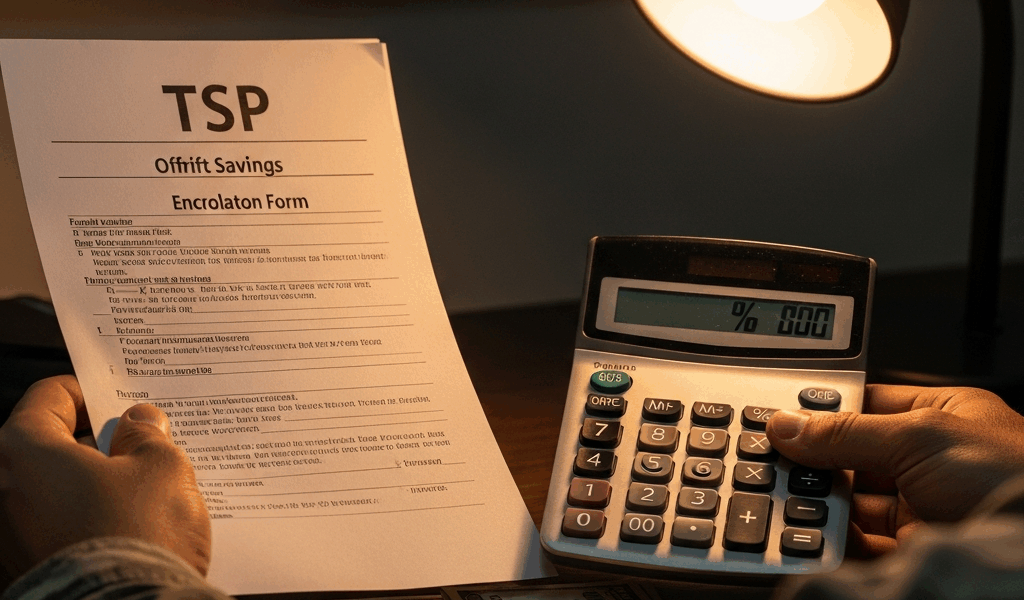
Why Most Troops Miss the TSP Match
I sat down with my first sergeant after two years of active duty and realized I’d been leaving money on the table the entire time. That’s when I learned about military TSP matching — and honestly, it’s one of the most straightforward financial wins available to service members that almost nobody claims.
Here’s what’s happening: The Department of Defense will give you free money toward your Thrift Savings Plan. Specifically, you can receive up to a 5% government contribution match on your salary. But here’s the catch that trips up most enlisted personnel — you have to contribute first. The match doesn’t happen automatically. You have to actively elect it, and if you don’t, that money disappears forever.
The numbers are absolutely brutal. Studies suggest somewhere between 40% to 60% of eligible service members never claim their full government matching contribution. That’s not speculation — it’s documented by the Federal Retirement Thrift Investment Board. For a junior enlisted soldier making $24,000 base annually, missing the 5% match means walking away from $1,200 per year. Over a 20-year career, with compound growth factored in, that’s potentially $50,000 or more in free government money you’ll never see.
The worst part? Setting this up correctly takes maybe 15 minutes.
Step-by-Step TSP Matching Enrollment Process
First, you need access to your pay account. Active duty personnel use mypay.dfas.mil — that’s where the actual contribution elections happen. Log in with your credentials, usually your social security number and whatever PIN you’ve set up.
Once you’re logged in, look for the “Leave and Earnings Statement” section or navigate directly to “Taxes and Withholdings.” From there, find the option labeled “TSP Election.” This is where the magic happens. You’re about to tell the military to start pulling money from your paycheck.
Here’s what I recommend: Set your contribution to 5%. That’s the magic number because the government will match every dollar you contribute up to 5% of your base salary. Put in 5%, they put in 5%. Put in 3%, they only match 3%. You’re leaving money on the table at anything less than 5%.
The contribution percentage gets applied to your next pay period once you’ve made the election. The system will ask you for an “effective date” — this is usually the next pay period or the first day of the next month. Your finance office can clarify if you’re uncertain whether you’re paid weekly or biweekly.
After you’ve entered 5%, the system asks which TSP fund you want the money invested in. Most service members default to the C Fund (common stock index) or a Lifecycle Fund matched to their retirement date. Either works fine for now. You can adjust this later — what matters at this exact moment is getting that election submitted.
Click confirm. You should see a confirmation screen or email. Take a screenshot if the system offers one. Close the browser window.
That’s enrollment. Done.
How Much Government Money You Actually Get
Let me put real numbers in front of you using current military pay scales.
An E-3 with a base salary of approximately $24,336 annually contributes 5% to TSP. That’s $1,216 per year coming from paychecks. The government matches that exact amount — $1,216 in free money. Roughly $101 per month extra going into your retirement account that you didn’t have to earn.
An E-5 with about $31,968 base salary. 5% contribution equals $1,598 per year. Government match: $1,598. That’s $133 per month in free money before investment gains.
An E-7 sitting at approximately $46,404 base. 5% contribution is $2,320 per year. Government match is $2,320. That’s $193 per month.
Now here’s where this gets really interesting. That money doesn’t just sit there — it gets invested in whatever TSP fund you selected. Using a reasonable fund mix and averaging something close to historical stock market returns of around 7% annually, your balance compounds over time.
After 20 years of service, an E-3 starting out has received $24,320 in total matching contributions from the government. Because of compound growth at 7%, that matching money alone has grown to approximately $52,000. You contributed nothing extra beyond your regular 5% election. The government handed you $24,000. Compound growth generated another $28,000. That’s what the math looks like.
This is why officers and senior enlisted personnel who started their TSP contributions early are often the wealthiest people in the unit — not because they make dramatically more money, but because they claimed their matching and let time do the work.
BRS vs Legacy Matching Rules — Quick Check
There’s a critical difference depending on which retirement system you’re under. If you joined before January 1, 2018, you’re under the Legacy High-3 system. If you joined after that date, you’re under the Blended Retirement System (BRS). The matching rules are completely different.
Under BRS: The government automatically contributes 1% of your base salary to TSP regardless of whether you contribute anything. Then they match dollar-for-dollar up to an additional 4%, meaning up to 5% total if you also contribute 5%. This is the better deal — you get free money automatically, plus matching.
Under Legacy High-3: There is no automatic government contribution. You only get what you match yourself through your contributions. No contribution from you, no match from the government. Zero.
To know which system you’re under, check your Leave and Earnings Statement (LES) or log into MyPay and look for your plan designation. It’ll clearly state “BRS Participant” or list you under the legacy system. Your finance office can confirm in about 30 seconds if you’re uncertain.
Verify Your Match Was Actually Applied
Probably should have opened with this section, honestly — because verification is where people sometimes find out something went wrong.
Your first check that the match was applied is your LES. Usually appears on the same pay period as your contribution is deducted. Look for a line item labeled “TSP Match” or “Government Contribution.” If you see a dollar amount there, it worked. If you don’t see it within one pay period of your election, something needs attention.
Your TSP statement is the official record. You can view this at tsp.gov by creating a separate TSP account — different login from MyPay. Your statement updates monthly and will show your contribution, the government match, fund allocations, and current balance. This is the source of truth for your account.
If your match doesn’t appear on your LES or TSP statement within two pay periods, contact your battalion or company finance office immediately. Bring your confirmation email from the TSP election. They can verify that the election processed correctly on their end. If there was a system glitch, they can resubmit it or correct the dates.
If finance office doesn’t resolve it within a week, contact the TSP directly at 1-877-968-3778. Have your Social Security number and service member ID ready. They can see your account status and tell you whether the contribution election actually went through or if there’s a delay on their system.
The match usually takes one to two pay periods to show up after your contribution is deducted. Sometimes three if you’re near a month end. But you should see evidence of it within roughly 60 days. If you’ve waited longer than that and see nothing, that’s a real problem that needs escalation.
The government is trying to give you this money. But only if you actually claim it and verify it arrived.



Leave a Reply