Both pays are $225 a month. Same amount, same line on your LES if it gets there, similar enough that most service members use the terms interchangeably. They aren’t the same. The trigger is different, the proration math is different, and the question that comes up every deployment — “can I get both?” — has a one-word answer: no.
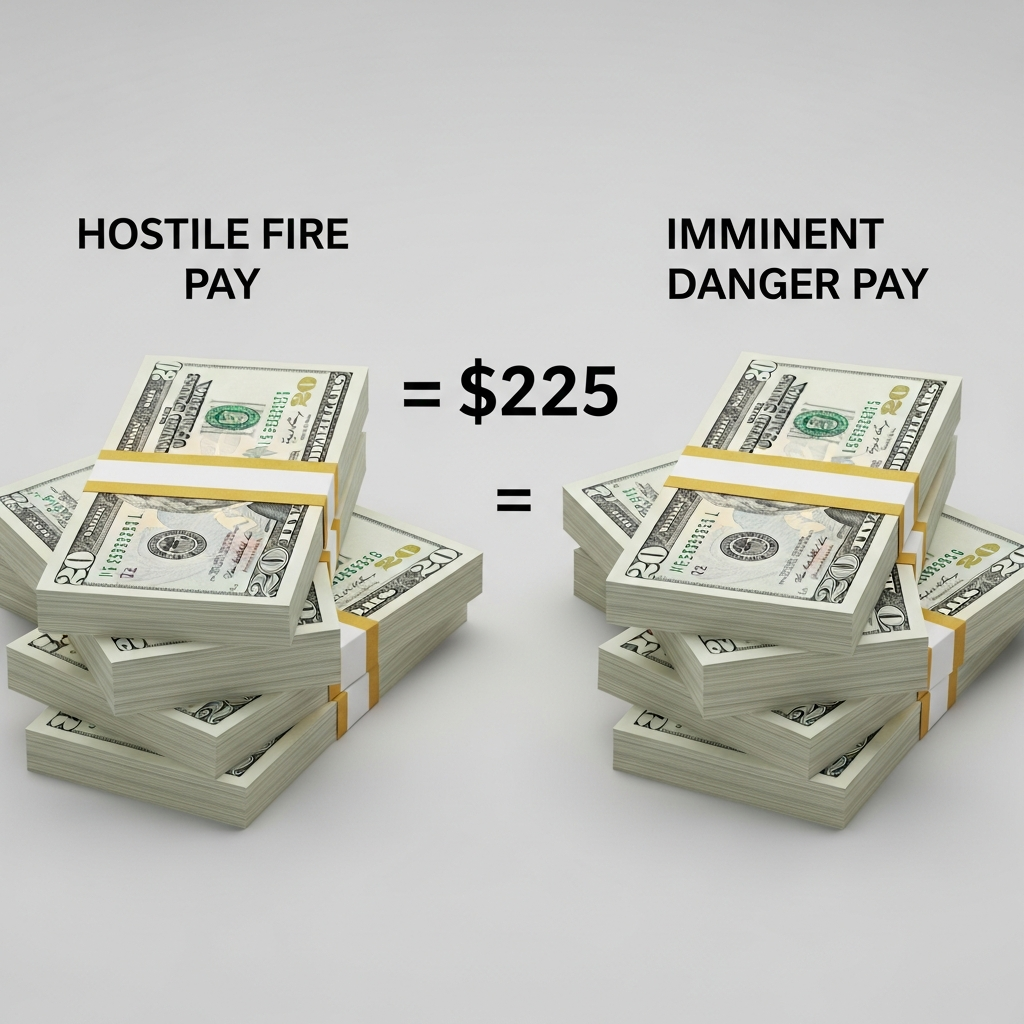
Here’s the side-by-side, then the details that finance offices and S-1s sometimes miss.
HFP vs IDP at a Glance
| Hostile Fire Pay (HFP) | Imminent Danger Pay (IDP) | |
|---|---|---|
| Trigger | Actual exposure to hostile fire, mine, or hostile action | Serving in a DoD-designated IDP location |
| Rate | $225/month | $225/month ($7.50/day) |
| Proration | None — one day of exposure = full month | Prorated daily — $7.50 × days in zone |
| Both at once? | No — mutually exclusive. DoD pays whichever is higher. | |
| Tax status | Tax-free if in a CZTE area | Tax-free if in a CZTE area |
| Documentation | Unit-level incident report | Orders showing duty in the designated location |
Hostile Fire Pay — Triggered by an Event, Not a Location
HFP is the older of the two pays and the one most service members think they’re getting when they’re really getting IDP. The trigger is exposure to a hostile act. Specifically, one of these has to happen:
- You were subjected to hostile fire or the explosion of a hostile mine
- You were on duty in an area in close proximity to a hostile fire incident, and the experts can establish you were in danger
- You were killed, injured, or wounded by hostile fire, mine explosion, or any other hostile action
The key word is exposure. You don’t have to be deployed to a war zone to get HFP. Air crews on missions over hostile airspace get it. Sailors on ships engaged in operations get it. Embedded advisors, special operations elements, and certain contractors get it. Anyone whose mission puts them in proximity to actual hostile activity qualifies.
The financial mechanic that catches people off-guard: HFP is not prorated. One day of qualifying exposure in a month earns the full $225 for that month. Two minutes of incoming fire on a routine convoy run on the last day of the month — full $225 for the month. This makes HFP meaningful for short-duration missions where the daily IDP rate wouldn’t accumulate enough to matter.
Documentation comes from your unit. The commander or designated authority files an HFP certification with finance after the incident. The incident report drives the entitlement. If your unit never filed it, you don’t get paid — which is why service members coming back from contingency operations should ask their S-1 to verify any HFP certifications submitted, not assume the system did it automatically.
Imminent Danger Pay — Triggered by Location, Prorated Daily
IDP is the broader of the two. You qualify simply by serving on official duty in a location that DoD has designated as an IDP area. No exposure required, no incident report, no certification beyond your orders showing you were there.
The rate is $7.50 per day, capped at $225 per month. Twenty days in a designated zone = $150. A full 30 days = the $225 cap. Partial-day arrivals and departures count as full days for IDP purposes — fly in on the 15th at 2300, you earned $7.50 for the 15th.
The list of IDP-designated locations changes over time as the global threat picture shifts. Some long-standing IDP areas:
- Most of the Middle East — Iraq, Syria, Yemen, parts of Saudi Arabia, Lebanon
- Parts of East Africa — Somalia, parts of Kenya, the Mali border region
- Afghanistan (still designated even after the withdrawal, for residual presence)
- Parts of West and Central Africa where US forces operate
- Specific maritime zones in the Red Sea and Gulf of Aden (active in 2026)
The complete current list is maintained at militarypay.defense.gov and updated quarterly. Don’t trust an older blog post for the current list — locations have been added and removed even in the last year as the Red Sea situation evolved.
If you’re operating in a designated maritime zone on a ship, IDP applies even when the ship is not making port. The Red Sea is a 2026 example — sailors on destroyers operating in those waters earn IDP for every day the ship is in the zone, regardless of whether they ever set foot ashore.
Can You Get Both HFP and IDP? No.
This is the question that comes up every deployment, often after a service member gets shot at while serving in an IDP-designated area. The intuitive expectation is that two qualifying triggers should yield two payments. They don’t.
HFP and IDP are mutually exclusive by statute. DoD pays whichever is higher for that month. Both pay $225/month at the full rate, so for any month where you earn the full HFP, the math is the same. The distinction matters in partial months:
- You arrive in an IDP zone on the 25th of the month. By month-end you’ve accumulated $7.50 × 6 days = $45 in IDP.
- On the 28th, the convoy takes incoming fire. You now qualify for HFP for that month.
- HFP is not prorated — you get the full $225.
- HFP > IDP, so finance pays HFP. The $45 in IDP is replaced, not added.
The reverse situation also matters. Long deployments in IDP zones without any hostile fire incidents will pay IDP every month for the full $225 (assuming the full month is in the zone). Adding an HFP-qualifying incident to one of those months doesn’t generate additional pay — it just swaps the line item on the LES.
Tax Status — Both Are Tax-Free in CZTE Areas
Both HFP and IDP qualify for Combat Zone Tax Exclusion when the location is also a CZTE-designated combat zone or direct support area. CZTE and IDP locations overlap heavily but they aren’t identical. A few zones earn IDP without being CZTE-designated, and a few CZTE areas don’t earn IDP — though the overlap is the rule, not the exception.
Practical implication: for enlisted members in a CZTE area, 100% of base pay, HFP/IDP, and most special pays are excluded from federal taxable income. The $225 you earn from HFP or IDP shows on your LES but doesn’t get taxed.
For officers, the CZTE exclusion is capped at the highest rate of enlisted pay plus HFP/IDP. The $225 HFP/IDP itself is excluded; what’s capped is the base pay portion.
More on how CZTE works — including the TSP Roth conversion strategy that turns deployment income into tax-free retirement growth.
Reservists, Air Crews, and Short Trips — The Edge Cases
Reservists on active duty. Reservists and Guard members on active duty orders qualify for HFP and IDP under the same rules as active-component service members. The pay is computed the same way and shows on the LES the same way. The 30-day FSA threshold doesn’t apply to HFP or IDP — they kick in immediately upon arrival in the zone or upon a qualifying incident.
Air crews and short missions. Pilots, navigators, and crew members on missions into hostile airspace earn HFP for any month containing a qualifying mission, regardless of how long the mission lasted. A bomber crew flying a single sortie over hostile territory on the 22nd of the month — even if they’re back at their MOB base the same night — earns the full $225 HFP for that month. This is the part of the rule that makes air operations financially distinct from ground operations.
Day trips through IDP zones. Brief stops in designated locations qualify. Refueling stops where the aircraft enters the IDP zone earn one day of IDP ($7.50). This is small money on a single trip but adds up for crews making frequent stops.
Embedded advisors and SOF. Special operations elements operating in non-designated areas can earn HFP based on the exposure trigger even when IDP doesn’t apply to the location. The classification of where they were operating may be handled at a higher level than the unit S-1 — verify through your chain that the HFP certification was filed.
See your full deployment pay stack — HFP/IDP + CZTE + FSA + BAH
The US Military Pay Calculator models HFP/IDP, FSA, and CZTE alongside base pay and allowances. Enter location and orders period, see the total. All ranks E-1 to O-10.
What to Check on Your LES
If you’ve been deployed in 2026 and your LES doesn’t show one of these lines:
- HFP in the Entitlements column for $225, OR
- IDP in the Entitlements column at $7.50/day prorated
Then either your orders don’t include a qualifying location or your unit didn’t file the certification. Walk into your S-1 with your orders and ask which one you’re set up for. The fix is usually a single form, often retroactive — back pay can be substantial if multiple months were missed.
And remember: HFP and IDP aren’t both paid in the same month. If finance applied HFP, the $45 of IDP you thought you earned earlier in the month wasn’t lost — it was upgraded.




Leave a Reply