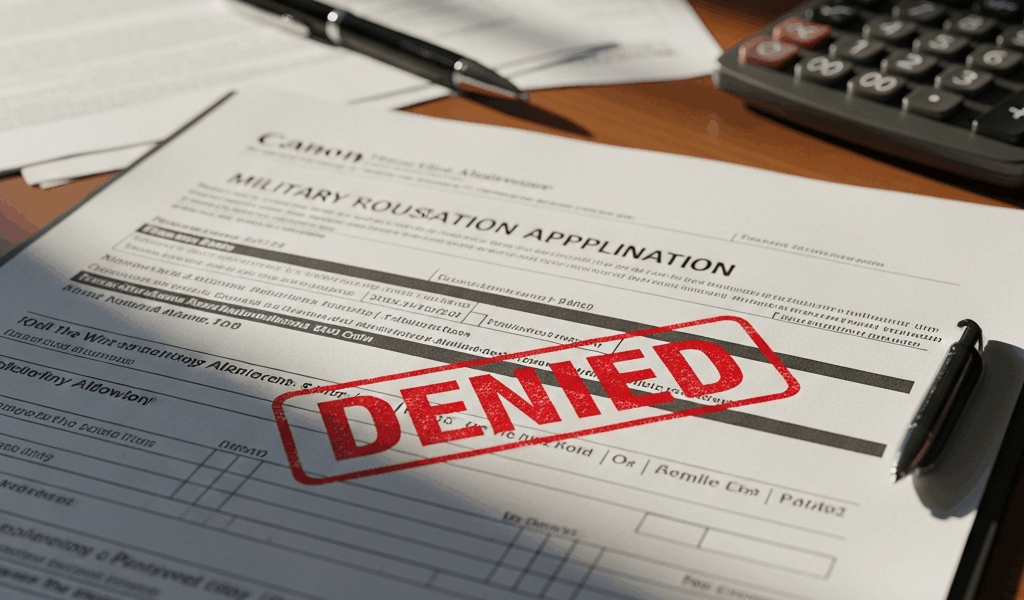
Military Housing Allowance Denied — What to Do Now
I found out my BAH claim got denied on a Friday afternoon, right before a long weekend. The finance office sent a one-paragraph email with a code I didn’t recognize, and suddenly I was staring at a housing payment shortfall with no clear next step. After spending three weeks working through the actual appeal process—talking to my finance officer, digging up old lease documents, and finally getting answers—I learned exactly what works and what wastes your time. If your military housing allowance denied status just landed in your inbox, here’s the specific troubleshooting guide I wish I’d had.
Why Your BAH Claim Got Rejected
Military finance systems reject BAH claims for concrete reasons, not administrative randomness. Understanding the actual reason matters because your response changes depending on what went wrong.
- Missing lease or rental agreement — You submitted a claim but no proof you actually rent. Finance needs your name on a signed lease, dated before or on the effective date of your claim. Post-dated leases? They kill claims immediately.
- Dependent verification failed — If you claimed a spouse or child, documentation didn’t match their name, Social Security number, or date of birth in the Defense Enrollment Eligibility Reporting System (DEERS). One transposed digit tanks the whole thing.
- Barracks assignment on file — You’re listed as residing in military housing—barracks, on-base housing, or a unit apartment—even though you’re claiming BAH. Finance won’t pay both. You need a formal out-processing document from your barracks manager. That’s non-negotiable.
- Address discrepancy — The address on your lease doesn’t match your orders, your ID card, or what’s in the military personnel system. An apartment number mismatch causes rejection. I’ve seen it happen.
- Marital status mismatch — You claimed BAH with a dependent spouse, but your DEERS record still shows single. Or the inverse—you claimed standard BAH, but the system finds a spouse on file. Divorce paperwork or a marriage certificate fixes this, but it has to update system-wide first. Patience required.
- Orders don’t cover the claim period — Your orders ended before your BAH claim started, or there’s a gap where you weren’t officially stationed anywhere. Permanent change of station (PCS) orders timing matters more than you’d think.
- Previous BAH claim still active — If you PCS’d and didn’t formally close your old housing claim, the new one conflicts with it. Both can’t run simultaneously. The system catches this immediately.
- Incorrect BAH category submitted — You filed as E-3 with dependents when your rank changed to E-4. Pay grade changes can invalidate the original claim amount. Rank advancement is good news. This denial isn’t.
Your denial letter should specify which reason applies. Probably should have opened with this section, honestly—grab that letter and identify the code before proceeding. It’ll save you from guessing. No point moving forward blind.
How to File a BAH Denial Appeal
The appeal process has actual steps. This isn’t bureaucratic theater; these are the moves that work.
Step One — Get the formal denial in writing with a reason code. Email your finance officer and request a typed denial letter that explains the specific reason, not just a system code. You need legible text stating why they rejected it. Ask for the effective date of the denial and the claim ID number. This usually takes 3–5 business days. If they’re slow, follow up with your commander’s finance advisor—usually a senior NCO or officer assigned to handle exactly this kind of issue. They exist for reasons like this.
Step Two — Assemble the corrected documentation. Once you know why it failed, pull together what’s actually missing. Don’t guess. If it’s a lease issue, get a certified copy of your rental agreement with your name and signature visible. If it’s a dependent problem, retrieve birth certificates and marriage certificates now—get certified copies if DEERS isn’t updating fast enough. This step takes 1–2 weeks depending on how quickly your landlord responds or how fast your county courthouse processes document requests. Call them first. Most courthouses have phone lines specifically for this.
Step Three — Submit the amendment using the right form. For most BAH corrections, you’ll resubmit using either the Statement of Personal History (SF 86) amendment or a corrected BAH claim form. Your finance office can tell you which form applies to your specific denial. Include a one-page cover letter explaining exactly what was wrong and what you’re correcting. Keep it factual: “Previous claim lacked signed lease. Attached certified copy dated [date]. Requesting reconsideration effective [original claim date].” Submit physically to the finance office. Email a copy to your finance officer by name. Keep a copy for yourself with a timestamp. Belt-and-suspenders approach works here.
Step Four — Track it and set a follow-up date. Ask for a tracking number or case reference when you submit. Mark your calendar for 14 days out. If you haven’t heard back, send a polite email requesting a status update. The system can move fast or slow depending on your duty station and how backed up finance is. Most reprocessing takes 10–30 days, but I’ve seen it stretch to 45 days if dependent verification has to route through DEERS. Patience is the price of admission here.
Documents You Actually Need to Resubmit
Stop guessing about paperwork. Here’s the checklist that actually clears denials.
- Signed lease or rental agreement — Must show your name, the landlord’s name, the address matching your claim, the monthly rent amount, the lease start date, and both signatures. If you’re in month-to-month tenancy, get a dated statement from your landlord confirming current occupancy and rent amount. Notarization isn’t always required, but some finance offices request it. Call ahead and confirm.
- Birth certificates (dependent children) — Certified copies only. Notarized or certified by the county clerk. Photo copies don’t work. Bring the originals in case finance wants to verify, but submit certified copies. Most counties charge $10–25 per certified copy. Budget for it.
- Marriage certificate (if claiming spouse) — Certified copy from the county where you married. If your name changed after marriage, bring documentation showing the name change. Most marriages shouldn’t expire, but if your marriage is older than 15 years, bring the original license in case questions arise about validity. It’s rare, but it happens.
- Divorce decree or custody order (if applicable) — If you’re claiming dependent children and the mother/father is not in your household, finance needs a court order establishing custody. A notarized agreement between parents isn’t sufficient. You need the official document with the judge’s seal. Non-negotiable.
- Out-processing paperwork from previous barracks — If you moved off-base and the system still lists you as in-barracks, get the official clearance document from your barracks manager or housing office showing your move-out date. This document usually comes from your old unit’s housing NCO. Some places call it a “clearing statement.” Ask for it by that term if they seem confused.
- Discharge paperwork or separation documents (if divorce is pending) — If your denial involves a spouse and you’re divorcing, you may need a notarized statement with the divorce filing date and case number, plus your intent to remove that dependent from your claim. This one varies by branch. Confirm with your finance office.
- Orders showing your duty station — A copy of your assignment orders, permanent change of station (PCS) orders, or duty station confirmation. Finance cross-checks these against BAH claims, so bring the official document. A photocopy is fine as long as it’s legible.
Most documents should be originals or certified copies—not just PDFs from your email. Bring physical copies to the finance office if possible. Mail works, but in-person submission with a timestamp photograph saves time if something gets lost. I’m apparently the type who takes photos. It works.
Who to Contact When Finance Office Ignores You
If the finance office stops responding, there’s an escalation path. Use it.
Level One — Commander’s Finance Advisor (10-day window) Every unit has a finance advisor, usually a seasoned NCO or warrant officer assigned specifically to handle soldier financial issues. Send them a detailed email explaining what you submitted, when, and that you haven’t received a status update. Include the tracking number and dates. They can push the finance office internally and usually get an answer within 10 business days. This person is your first ally. Treat them accordingly.
Level Two — Inspector General (IG) hotline (30-day window) If the finance advisor doesn’t help or doesn’t exist at your unit, the IG handles command financial fraud and negligence complaints. Most installations have a dedicated IG line or email for financial claims issues. Document everything: submission dates, finance officer names, emails sent, and lack of response. The IG escalation usually triggers a reply from finance within 30 days. They take paperwork seriously. IG involvement gets attention fast.
Level Three — Judge Advocate General (JAG) office (if legal recourse) If the denial appears to be improper or the finance office has flagrantly ignored a valid claim, JAG can review it. This step assumes you’ve exhausted internal channels first. JAG won’t fight for you, but they can advise if the denial violates regulation and what your legal standing is. It’s a last resort, but it exists.
Phone numbers vary by installation, so check your post directory or ask your unit. Email trails matter—always request confirmation when you escalate. Screenshot everything.
BAH Denial and Back Pay Recovery
If your appeal succeeds, here’s what happens next with your money.
Back pay eligibility runs from your original claim date, not your appeal approval date. If you filed BAH on January 15 and they denied it but approved your appeal on March 20, you’re entitled to the full BAH for January, February, and March once it clears. The reprocessed payment can take another 2–3 pay periods to appear in your account. Direct deposit is typical, but check with your finance office about processing timeline. Some installations batch-process back pay; others run it individually. Neither is faster or slower—it’s just how your post operates.
The statute of limitations on BAH claims runs three to five years depending on your service branch, but don’t rely on that cushion. Submit appeals within 90 days of denial whenever possible. After that window, some finance offices argue the claim is “stale” and resist reopening it, even if you’re legally entitled. Don’t make my mistake. Move fast.
Reprocessing timelines are genuinely unpredictable. I submitted corrected documents on a Tuesday and had approval by the following Thursday. A friend submitted the same week and waited six weeks. The difference was whether dependent verification needed to route through DEERS or if it was an obvious documentation fix. Ask your finance officer for a realistic timeline based on your specific denial reason. They’ve processed hundreds of these. They’ll know.
In the worst case, if the denial stands after two appeals and you believe it’s genuinely erroneous, you can request a formal review by your branch’s accounting section. This is rare and usually requires JAG involvement, but it exists. Don’t assume you’re stuck. The system has a floor—you’re not losing money permanently without exhausting the actual options. There’s always another step.


Leave a Reply