Military BAH With Dependents vs Without Explained
Military BAH has gotten messy with all the conflicting information flying around. I watched servicemembers walk away from my counter genuinely baffled about why their buddy was pulling more BAH on the same pay grade. and I’ll skip straight to the numbers that actually matter.
What Counts as a Dependent for BAH Purposes
But what is a qualifying dependent, exactly? In essence, it’s anyone legally tied to you through marriage, birth, adoption, custody, or court order. But it’s much more than that simple list suggests.
Most people assume it means spouse and kids — full stop. It also includes stepchildren, foster children under specific conditions, and even a parent or sibling you’ve had designated as a legal dependent through a court order. That last one surprises almost everyone.
Here’s the part people miss: you only need one qualifying dependent to hit the with-dependents rate. One. Doesn’t matter if you have a single child or five. The rate doesn’t scale with headcount. A servicemember who gets married on a Friday and updates their records by Monday gets the with-dependents rate backdated to the wedding date — not the day finance finally touched the paperwork.
- Spouse (including same-sex spouse)
- Biological, adopted, or stepchildren under 23 if enrolled in school, or under 21 otherwise
- Children of any age incapable of self-support due to a disability
- Legal dependents established by court order (parents, siblings)
Children don’t need to live under your roof either. A servicemember paying child support for a kid from a previous relationship still qualifies for the with-dependents rate — provided the child is enrolled in DEERS and the dependency is documented. Don’t repeat what I did of assuming physical custody is required. It isn’t.
How Much More BAH You Get With Dependents
Here’s the part worth saying first. This is what everyone actually wants to know.
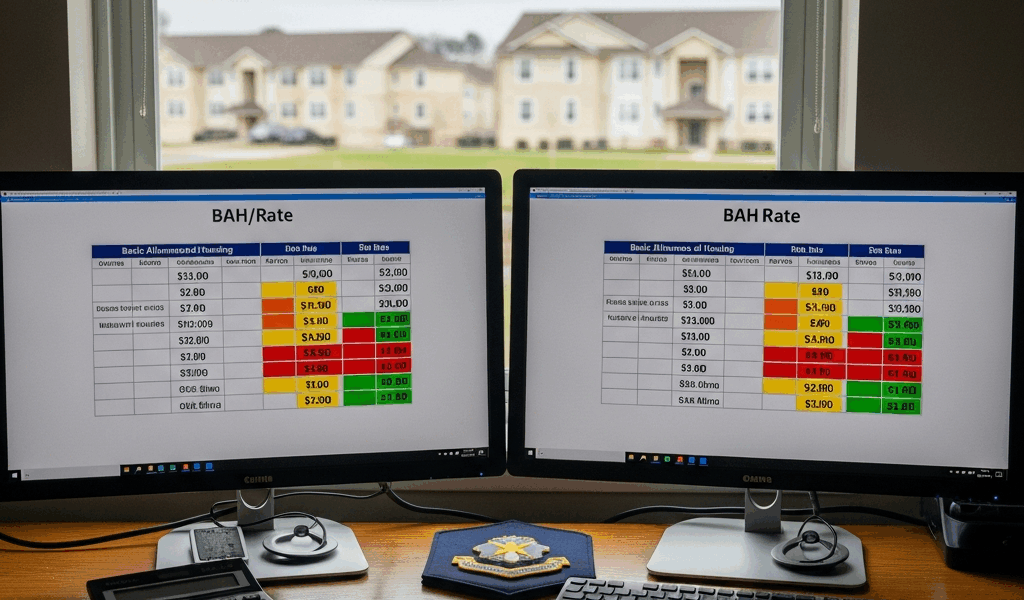
The table below uses 2026 BAH rates for ZIP code 28547 — Jacksonville, NC, home of Camp Lejeune. It’s a mid-cost military town and a realistic reference point. These figures come straight from the 2026 DoD BAH tables.
| Pay Grade | Without Dependents | With Dependents | Monthly Difference |
|---|---|---|---|
| E-4 | $1,443 | $1,755 | +$312 |
| E-5 | $1,530 | $1,848 | +$318 |
| E-6 | $1,620 | $1,968 | +$348 |
| O-2 | $1,755 | $2,106 | +$351 |
| O-3 | $1,962 | $2,358 | +$396 |
That’s $312 to $396 extra each month depending on grade — somewhere between $3,744 and $4,752 over a full year. For a fresh E-4 who just got married, that $312 is a car payment. It’s three months of groceries for a small family. Real money. That’s what makes BAH dependent status so significant to junior enlisted servicemembers specifically.
Now look at a higher cost-of-living market. Same pay grades, ZIP code 92134 — San Diego, CA:
| Pay Grade | Without Dependents | With Dependents | Monthly Difference |
|---|---|---|---|
| E-4 | $2,520 | $3,138 | +$618 |
| E-5 | $2,700 | $3,321 | +$621 |
| E-6 | $2,898 | $3,537 | +$639 |
| O-2 | $3,060 | $3,762 | +$702 |
| O-3 | $3,375 | $4,194 | +$819 |
In San Diego, an E-4 with dependents pulls over $600 more per month than their counterpart without. The gap scales with local cost of living — which is exactly how the system was designed to work.
Why the Rate Difference Exists — Who Sets It
The Department of Defense runs an annual median rental cost survey. The logic behind the gap is straightforward: a single servicemember needs a one-bedroom unit. A servicemember with dependents needs at least two bedrooms. DoD surveys actual rental listings across every military housing area, calculates local medians, and sets BAH to cover that median cost. The with-dependents rate reflects a larger unit. That’s it — no “family bonus” hiding inside the formula. It’s purely square footage and bedroom count. The Office of the Under Secretary of Defense for Personnel and Readiness manages the annual review and typically drops updated rate tables each December for the following January.
When Your BAH Rate Changes After Dependent Status Changes
Marriage
Your with-dependents rate is effective on the date of marriage. Not the date you filed the paperwork. Not the day finance processed anything. The actual wedding date. Keep a physical copy of your marriage certificate — you’ll need it to claim back pay if processing drags out longer than it should.
New Child
Already receiving the with-dependents rate through your marriage? A new child changes nothing on the BAH side. You’re already at the ceiling. If you’re single and become a custodial parent — through birth, adoption, or court-ordered custody — the with-dependents rate kicks in on the date that custody is legally established. Not before.
Divorce
Frustrated by this rule the first time I saw it applied to someone at my counter. If you divorce but retain custody of a child, you keep the with-dependents rate. No change. If you divorce with no children and no other qualifying dependents, you drop back to the without-dependents rate — effective the date the divorce decree is finalized. Not the separation date. The finalized decree date. I’ve seen servicemembers get blindsided by that distinction and end up owing money back.
Child Aging Out
A child who turns 21 — or 23 if a full-time student — gets removed from DEERS automatically. If that child was your only qualifying dependent, your BAH reverts to the without-dependents rate immediately. Watch this one closely. I’m apparently someone who saw this bite servicemembers repeatedly, and an overpayment collection notice works for the government while it never works well for the E-5 receiving it. Steer clear of where I went wrong of assuming DEERS catches everything without your involvement.
Rate Protection
If BAH rates in your area drop year-over-year and you’re already locked into a higher rate, you’re protected. Your rate won’t fall below what you were receiving — as long as your dependency status and duty station stay the same. A new assignment resets that protection entirely.
How to Update Your Dependent Status to Get the Right Rate
The single most common mistake I watched servicemembers make: walking straight to finance. Don’t do that. DEERS first, finance second. So, without further ado, let’s dive in.
- Enroll your dependent in DEERS. Head to your nearest ID card office — a RAPIDS site — with your marriage certificate, birth certificate, or court order. Bring two forms of ID. Your dependent must appear in DEERS before finance can touch any of it.
- Submit the dependency update through myPay or your unit S1. Once DEERS reflects the dependent, log into myPay and update your dependency status, or submit a DD Form 1172-2 through your unit’s personnel office. Most S1 offices can process this same-day if your paperwork is complete.
- Check your LES the following month. Your Leave and Earnings Statement should show the updated BAH rate. If it doesn’t, contact finance immediately — bring your DEERS enrollment date as proof of when the effective date actually was.
What happens when processing lags? If your DEERS enrollment date precedes your pay change date, you’re entitled to retroactive BAH at the with-dependents rate back to that enrollment date. Finance issues the back pay as a one-time correction on a future LES. Conversely, fail to report a lost dependent and you’ll owe the overpayment back — collected through a payment plan pulled from future paychecks. Neither situation is catastrophic. Update DEERS within 30 days of any status change and you’ll almost never face either one.



Leave a Reply