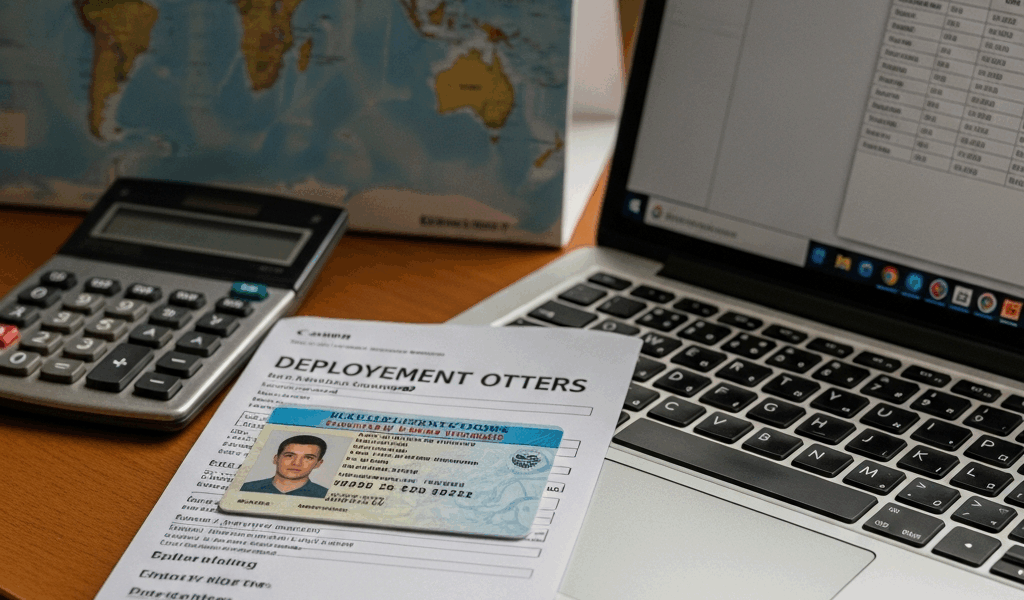
Use the official OHA calculator: Open the Defense Travel Management Office OHA page and select its OHA calculator. Enter the duty country or area, locality, pay grade, dependency status, and effective date. OHA rates and currency conversions can change, so an official lookup is more reliable than a static rate table.
What Is Overseas Housing Allowance?
Overseas Housing Allowance (OHA) is a cost-reimbursement allowance for authorized service members assigned to permanent duty overseas who lease private housing. It is not a single flat housing payment like stateside BAH. The amount depends on the approved lease, location ceilings, utilities, dependency status, pay grade, and current currency conversion.
OHA has three principal components:
- Rental allowance: reimburses actual approved rent up to the applicable maximum.
- Utility and recurring-maintenance allowance: helps cover eligible utilities and recurring housing expenses paid separately from rent.
- Move-In Housing Allowance (MIHA): helps with certain one-time costs of occupying privately leased housing.
How to Use the Official OHA Calculator
- Go to the official DoD OHA page.
- Open the OHA calculator or rate lookup.
- Select the effective date for the rate you need.
- Choose the country or area and the correct locality code.
- Select the member’s pay grade and with-dependent or without-dependent status.
- Review the rental ceiling, utility/recurring-maintenance allowance, and any applicable MIHA amount.
- Compare the lookup with the approved lease, DD Form 2367, and LES. The rental ceiling is not automatically the amount paid.
For Guam, Germany, Japan, Korea, Italy, the United Kingdom, and other locations, always use the locality shown in the official calculator. A nearby city or installation can have a different code and ceiling.
Why the Rental Ceiling Is Not Your Automatic Payment
OHA reimburses approved rent up to the lower of two amounts: the actual lease amount or the applicable rental allowance ceiling. If the approved rent is below the ceiling, the member generally receives the approved rent amount—not the unused difference.
Example: if an approved lease converts to $1,700 and the applicable ceiling converts to $2,000, the rental component is generally based on $1,700. If the approved lease is $2,200, reimbursement is generally limited to the $2,000 ceiling, leaving potential out-of-pocket cost. Currency fluctuations can change the U.S.-dollar value without changing the foreign-currency rent.
With Dependents vs. Without Dependents
Dependency status affects OHA components. According to DTMO, members without dependents generally use 90% of the with-dependent rental ceiling. For members paying utilities separately, the without-dependent utility/recurring-maintenance rate is generally 75% of the with-dependent rate.
“With dependents” is a status, not a per-dependent multiplier. Having additional dependents does not add a separate amount for each person. Dual-military, custody, unaccompanied-tour, and geographic-separation situations can require an individual entitlement determination.
Utility and Recurring-Maintenance Allowance
This monthly component helps defray eligible utilities and recurring maintenance paid directly by the member. If utilities are included in rent, the treatment differs from a lease where the member pays providers separately. DTMO uses reported expense data to set the allowance, and the utility rate is reviewed annually.
Keep utility bills and follow the installation housing and finance instructions. The allowance is not a promise that every household’s exact utility bill will be reimbursed.
Move-In Housing Allowance (MIHA)
MIHA can partially cover certain up-front overseas leasing costs. DTMO identifies several components, including MIHA/Miscellaneous and, where authorized, MIHA/Rent, MIHA/Security, MIHA/Infectious Disease, and MIHA/Safety.
MIHA/Miscellaneous can cover typical expenses needed to make a dwelling habitable, such as transformers or utility connections. Other MIHA components require specific eligibility and documentation. They are not automatic in every country or lease.
How to Apply for OHA
OHA is not established merely by using the calculator. The member generally submits:
- DD Form 2367, Individual Overseas Housing Allowance Report;
- a copy of the lease;
- orders and dependency documentation required by the service or installation; and
- DD Form 2556 when claiming applicable MIHA/Rent, MIHA/Security, or MIHA/Infectious Disease expenses.
Submit documents through the local housing and finance process. Do not sign an unaffordable lease based only on the maximum shown in a public calculator; obtain the required review or approval first.
How Often OHA Rates Change
Rental allowances are reviewed and adjusted every six months using rent data reported through finance systems. Utility/recurring-maintenance allowances are reviewed annually, while MIHA/Miscellaneous uses periodic survey data. The U.S.-dollar payment can also change with foreign-currency exchange-rate adjustments.
That is why copied country tables and old screenshots become unreliable. Use the effective-date field in the official calculator for current or historical research.
Is OHA Taxable?
OHA is generally excluded from federal gross income as a qualified military living allowance. IRS Publication 3 lists OHA among military living allowances excluded from gross income. Basic pay is treated differently and is generally taxable unless a specific exclusion applies.
OHA vs. BAH
| Feature | OHA | BAH |
|---|---|---|
| Typical use | Authorized private housing at an overseas permanent duty station | Housing allowance primarily for U.S. duty locations |
| Payment design | Cost reimbursement with rent ceiling, utilities, and possible MIHA | Published rate based on grade, dependency status, and duty location |
| Actual rent considered? | Yes; rental payment is generally limited by actual approved rent and ceiling | No; actual rent does not set the BAH rate |
| Currency effect | Yes, foreign exchange can affect the dollar payment | No foreign-currency conversion |
Read our BAH versus BAS guide for the separate housing and food allowance rules.
Common OHA Problems
The Calculator Shows More Than the LES
The public result may show a maximum ceiling, while the LES reflects approved actual rent, dependency status, utility treatment, exchange rates, or an effective-date difference. Compare the same locality and date, then ask finance to review the DD Form 2367.
The Locality Is Wrong
Do not guess from the nearest well-known city. Confirm the locality code with the installation housing office before signing the lease or disputing the rate.
OHA Changed Without a New Lease
The U.S.-dollar amount can change when currency conversion changes. Rental ceilings or utility allowances can also be updated. Compare the current and prior effective dates in the official lookup.
OHA Is Missing After Arrival
Confirm that the lease, DD Form 2367, orders, and dependency documentation were accepted and processed. Keep copies and ask the local finance office for the transaction status. The online calculator itself does not start payment.
OHA Calculator Checklist
- Use the official DTMO calculator, not an undated third-party table.
- Choose the correct effective date and locality.
- Use the authorized grade and dependency status.
- Distinguish the rental ceiling from actual reimbursable rent.
- Check whether utilities are included in the lease.
- Review MIHA eligibility separately.
- Compare the result with approved forms and the LES.
Fact-checked July 2026 using the Defense Travel Management Office OHA guidance and calculator, DTMO OHA survey guidance, and IRS Publication 3. Individual entitlements depend on approved orders, lease documentation, and the servicing housing and finance offices.


Leave a Reply